Avarej Lus
House edgematematikEdj bilong kasinoHap bilong olgeta mani bilong bet kasino i holim long avarej: 2.70% long rulet bilong Yurop.Ritim olgeta → times the amount wagered: how to calculate expected loss.

Avarej lus = olgeta mani yu betim × 1/37. Bet $10, 100 tanim: yu betim $1,000, avarej lus $27. Ol progresen i betim planti moa, olsem na ol i lus planti moa.
Olgeta mani yu betim, i no mani bilong pilai
Expected lossmatematikAvarej lusEkspektet velyu taims olgeta mani yu betim; avarej mani yu lusim long wanpela sesen o long wanpela taim.Ritim olgeta → depends on how much passes across the table, not on how much you brought. Completing $2,000 of standard single-zerowilSiroWanpela grinpela hul we i no gat bet wan-long-wan, dosen o kolam i karamapim; em i as bilong edj bilong kasino. Narapela nem: wanpela siro, 0.Ritim olgeta → bets gives an expected loss of $54.05. A $100 starting bankrollmaniMani bilong pilaiOlgeta mani yu putim long sait bilong pilai. Lukautim mani bilong pilai em i makim hamas long en yu redi long lusim long wanpela bet na long wanpela sesen.Ritim olgeta → might or might not last long enough to complete that turnovermaniOlgeta mani yu betimOlgeta mani yu betim long wanpela sesen o long wanpela taim, wantaim mani yu win na yu betim gen. Narapela nem: handle, action.Ritim olgeta →. A single $10,000 bet on redbetRetBet wan-long-wan long 18 namba ret. Tok Frans: rouge.Ritim olgeta → has an expected loss of $270.27. These are averages, not deductions or limits on the actual loss.
Fomula
For a fixed schedule of standard single-zero bets, E[loss] = total stakes / 37. With stakes or stopping times that depend on earlier results, expected loss is expected turnover / 37, provided expected turnover is finite. The table shows fixed-stake examples, assuming all 100 spins are completed. ProgressionstratejiProgresenWanem lo i senisim mani bilong bet long ol resal i go pinis. Negative progresen i mekim bet i go antap bihain long lus, positive progresen bihain long win.Ritim olgeta → averages require a specified bankroll, limit, stopping rule and simulation or calculation.
Spit
Ol tebol i laiv i ranim 40–60 tanim long wanpela aua, ples pilai bilong kasino 30–50, ol tebol bilong spit 90 o moa, ol tebol bilong RNG kwik olsem yu klikim. Long wankain mani bilong bet, spit em i bikpela samting moa i senisim avarej lus long wanpela aua: sapos yu lusim tebol i isi long ples pilai na yu go long tebol bilong RNG long 200 tanim long wanpela aua, pe bilong nait i go antap fopela taim, na ods i no senis.
Long wanpela yia
At 50 spins per hour, two hours per week and $10 per spin for 52 weeks, total turnover is $52,000. Expected loss is about $1,405 on standard single-zero bets, $703 on la partageloLa partageLo bilong Frans: taim siro i kamap, hap bilong mani bilong bet wan-long-wan i kam bek. Em i katim edj bilong kasino long ol dispela bet long hap, i go daun long 1.35%.Ritim olgeta → even-money betsbetBet wan-long-wanRet/blak, od/iven, antap/daunbilo. 18 namba, pe em i 1:1.Ritim olgeta →, or $2,737 on standard double-zero bets other than the five-number bet. These figures assume every scheduled bet is made. Fewer bets, smaller stakes or a lower edge reduce expected loss; actual results remain uncertain.
Pilai i gat velyu i winim olgeta beng
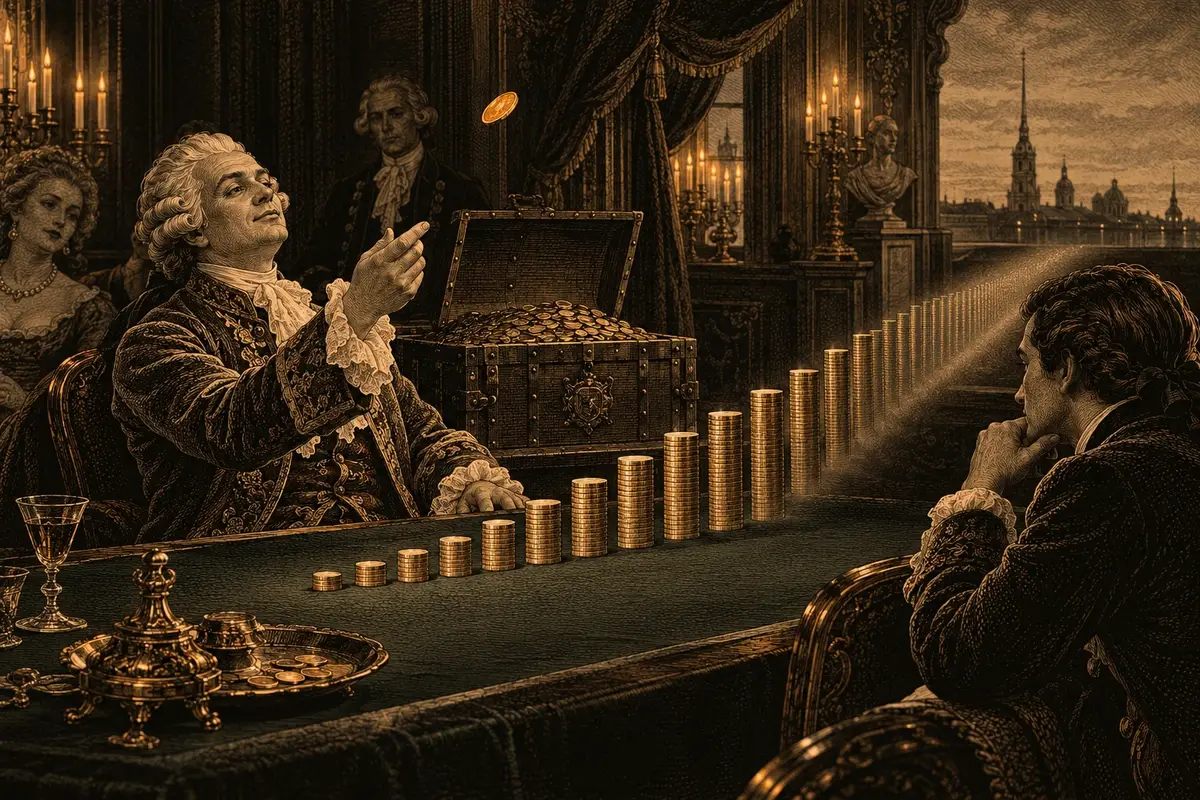
The St. Petersburg game, posed by Nicolaus Bernoulli in 1713, tosses a coin until it lands heads and pays $2 if that takes one toss, $4 if two, $8 if three, doubling each time. Every possible length adds $1 to the expected valuematematikEkspektet velyuAvarej resal long wanpela bet long longpela taim. −1/37 bilong mani bilong bet long olgeta bet olpasin bilong Yurop.Ritim olgeta →, so on paper the game is worth an infinite amount. No bank can pay infinite prizes, and once the prizes are capped at what the bank holds, the value collapses: with a bank of $1 million the game is worth about $21, with $1 billion about $31. The comparison with MartingalestratejiMartingaleProgresen i mekim bet i dabel bihain long olgeta lus. Lukim hap Strateji long wanem samting em i mekim na i no mekim.Ritim olgeta → is the importance of limits: a theoretical doubling sequence can require stakes beyond any finite bankroll or table limittebolMak bilong tebolBet liklik tru na bet bikpela tru ol i larim. Mak antap em i samting i stopim ol progresen i save dabel.Ritim olgeta →. That does not make the two games identical. A failed progression need not lose the entire bankroll, and a short session can finish ahead.
Avarej lus i no samting i kamap
A single session can differ greatly from its expected loss. For 100 independent standard single-zero even-money bets at $10 each, the net result has a standard deviationmatematikStandet diviesenSkwea rut bilong varians; hamas longwe resal i save stap long ekspektet velyu.Ritim olgeta → of about $99.96 and an expected value of −$27.03. A winning session is possible. Expected loss describes the average across repeated sessions under those assumptions; it is neither a fee nor a limit on what one session can lose.
Fomula
Ol askim
No fixed percentage is deducted from your buy-intebolBaim sipSenisim mani kes long sip long tebol. Yu mekim namel long tupela tanim, na yu putim mani long laiaut, yu no givim long han bilong dila.Ritim olgeta →. For standard bets on a fair single-zero wheel, expected loss is about 2.70% of the amount wagered. Actual results vary. Re-betting winnings adds to the amount wagered.
With the same rules and number of bets, a smaller fixed stake lowers expected loss. The probabilitymatematikSansSans bilong wanpela resal, long 0 i go 1 o 0% i go 100%. Wanpela namba: 1/37 = 2.70%.Ritim olgeta → of reaching a profit target is a different question and also depends on bankroll, stake and stopping rules.
Ol kasino i skelim avarej lus bilong yu long avarej bet na hamas taim yu pilai, na ol i givim bek liklik hap bilong en olsem presen. Ol i givim bek hap bilong pe tasol, ol i no givim edj long yu.
Liklik lap
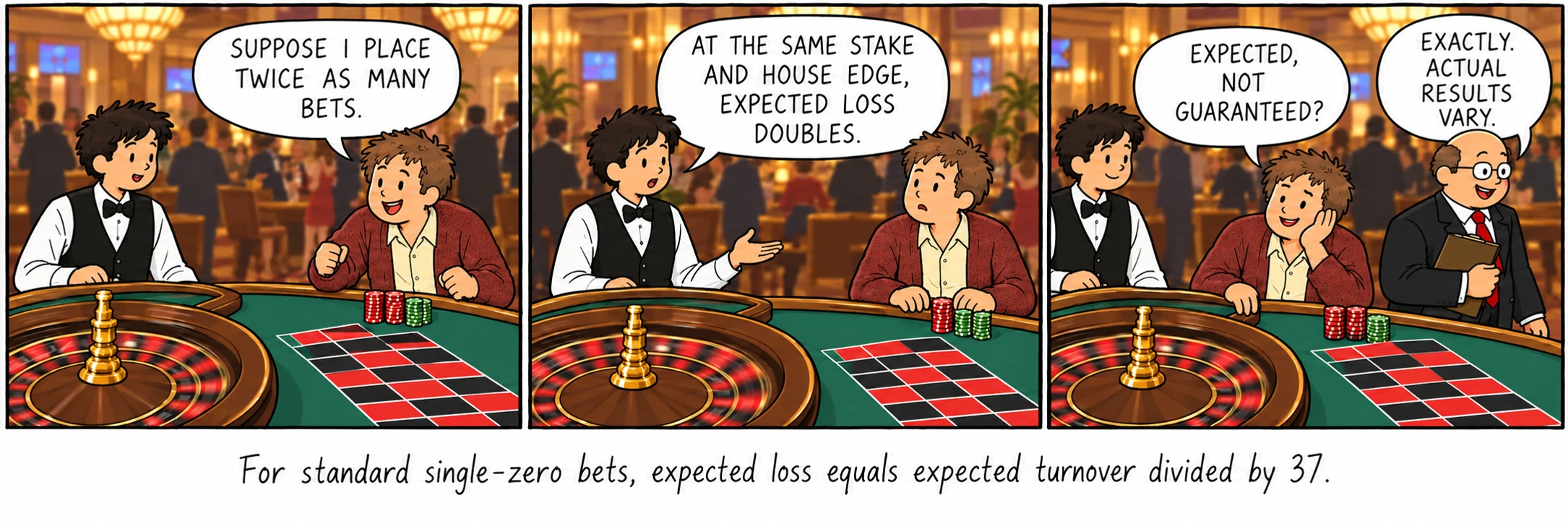
Olgeta mani yu betim × 1/37. Klok i stap insait long fomula.
Ol As bilong Save
- Ethier, S. N. The Doctrine of Chances: Probabilistic Aspects of Gambling.
- Epstein, R. A. The Theory of Gambling and Statistical Logic, 2nd ed.
- Taylor, D. G. Games, Gambling, and Probability: An Introduction to Mathematics, 2nd ed.