Standet Diviesen long Rulet
Standet diviesen bilong rulet, em i skwea rut bilong variansmatematikVariansMak bilong hamas ol resal i kalap nabaut long ekspektet velyu. I bikpela long bet long wanpela namba, i liklik long bet wan-long-wan.Ritim olgeta →, em i hamas samting i kamap i save stap longwe long avarej.
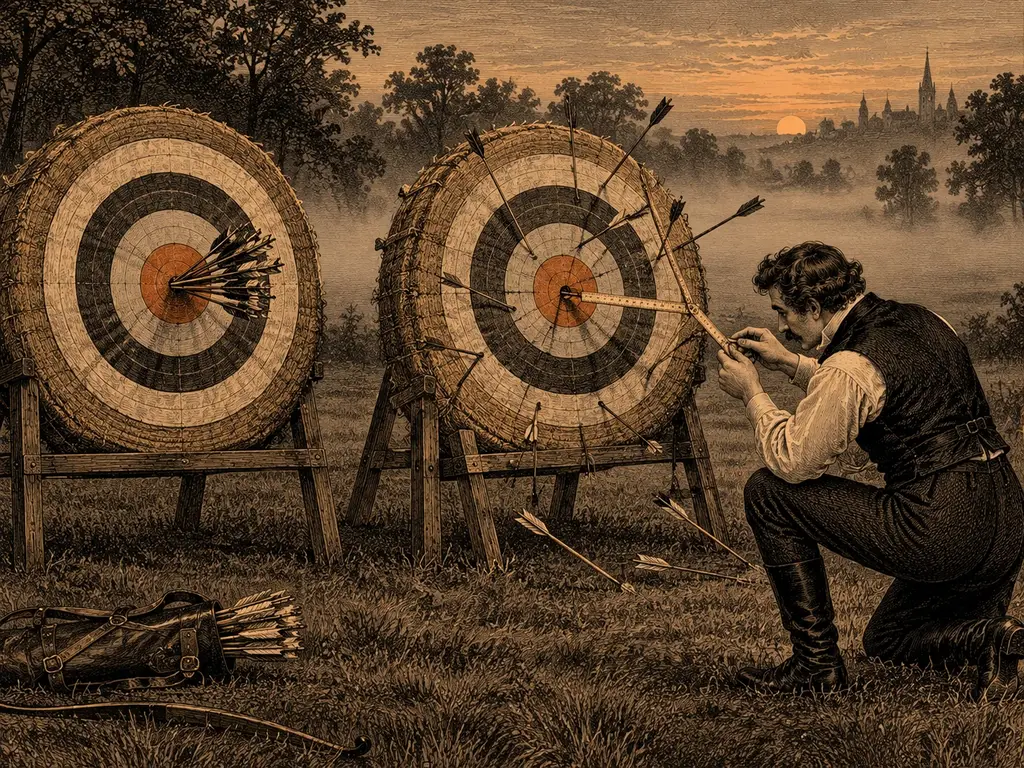
Per $1 staked, σ is 5.84 for a straight upbetWanpela nambaWanpela namba tasol, pe em i 35:1.Ritim olgeta → and 1.00 for red. For independent spinsmatematikOl tanim i no hangamap long narapelaOlgeta tanim i gat wankain sans, maski wanem samting i kamap bipo. Olgeta kaunim long dispela sait i sanap long dispela.Ritim olgeta → with the same bet and stake, multiply by the stake and the square root of the number of spins.
Isi rot bilong tingim
When a normal approximation is suitable, about 68% of results lie within one standard deviationmatematikStandet diviesenSkwea rut bilong varians; hamas longwe resal i save stap long ekspektet velyu.Ritim olgeta → of the mean and 95% within two. These are approximations, not universal rules. For 100 independent $10 bets on redbetRetBet wan-long-wan long 18 namba ret. Tok Frans: rouge.Ritim olgeta →, the expected result is about −$27 and the standard deviation is $100. The exact binomial probabilities below account for the fact that final results come in $20 steps. An unusual session alone does not establish an advantage.
Bilong wanem √N
Expected lossmatematikAvarej lusEkspektet velyu taims olgeta mani yu betim; avarej mani yu lusim long wanpela sesen o long wanpela taim.Ritim olgeta → grows in proportion to N; spread grows in proportion to √N. For short sessions, random variation can be large compared with the expected loss. As N grows, expected loss becomes larger relative to that spread. The crossover, where expected loss equals one standard deviation, is at N = (σ/edge)². Using unrounded single-zerowilSiroWanpela grinpela hul we i no gat bet wan-long-wan, dosen o kolam i karamapim; em i as bilong edj bilong kasino. Narapela nem: wanpela siro, 0.Ritim olgeta → values gives 1,368 spins for even-money betsbetBet wan-long-wanRet/blak, od/iven, antap/daunbilo. 18 namba, pe em i 1:1.Ritim olgeta → and 46,656 for straight-up bets. This is a comparison of scales, not a point at which outcomes become certain.
Olsem wanem long yusim
To judge whether a session was unusual, compute (result − EV)/σ. A $10 red bettor who finishes 100 spins at +$160 has won 58 spins and lost 42. That result is about (160 + 27)/100 = 1.87 standard deviations above the mean. The exact probabilitymatematikSansSans bilong wanpela resal, long 0 i go 1 o 0% i go 100%. Wanpela namba: 1/37 = 2.70%.Ritim olgeta → of finishing at +$160 or better is about 3.82%. The z-score describes distance from the mean; use the actual outcome distribution to calculate a tail probability.
Standet rong bilong wanpela hap
Dispela kaunim yet i tokim yu hamas tanim yu nidim long lukim edj long ol namba. Standet rong bilong hap bilong win yu lukim em i √(p(1 − p)/N). Long ret wantaim N = 1,000: √(0.4865 × 0.5135 / 1000) ≈ 1.6%. Namel long stretpela koin na ret i gat 1.35%, olsem na bihain long 1,000 tanim yu no inap yet long tokaut strong olsem tupela i narakain. Bihain long 10,000, standet rong em i 0.5% na yu inap. Olsem na long painimaut bias bilong wil yu nidim planti tanim tru.
Lukaut long namba i go long wanpela sait
Straight-up results are far from normally distributed in a short session: most sessions are a steady −$10 per spin with occasional +$350 jumps. The standard deviation remains valid, but the normal 68%/95% rule can be misleading. For even-money bets, the normal approximation becomes more useful as the number of spins grows; an exact binomial calculation avoids approximation error.
Fomula
Ol askim
Em i soim olsem yu bin pilai klostu 40 sesen, o yu bin stap long dispela wanpela long foti i gat gutpela luk. Mekim gen.
For independent spins with a fixed bet and stake, the standard error of the average is σ/√N. At 10,000 spins it is about 1% of the stake for red, but about 5.84% for a straight-up bet. The spread shrinks with N; the observed average need not move steadily toward its expectation.
Amamas wantaim Matematik
Traim ol dispela yu yet pastaim. Bekim bilong wanwan i hait; opim taim yu redi.
Long 100 tanim bilong wil bilong Yurop, wanpela yunitmaniYunitMani bilong bet bilong stat we wanpela sistem o wanpela pleia i wok long en. Ol i stori long ol progresen long yunit, olsem na ol i ken wok long wanem tebol.Ritim olgeta → long retbetRetBet wan-long-wan long 18 namba ret. Tok Frans: rouge.Ritim olgeta → i stap antap wantaim 51 win o moa, na wanpela yunit long bet long wanpela nambabetWanpela nambaWanpela namba tasol, pe em i 35:1.Ritim olgeta → i stap antap sapos namba bilong en i kamap 3 taim o moa. Yusim bel kev long tingim tupela sans, na bihain skelim wantaim ol bekim stret.
Soim bekim
Bekim Ret: bel kev i givim 35.6% na bekim stret em 35.5%. Wanpela namba: bel kev i givim 55.0% na bekim stret em 50.9%. Sotpela rot i wok long ret na i no stret long wanpela namba.
Ret: ol win i gat avarej 100 × 18/37 = 48.6, wantaim senis bilong √(100 × 18/37 × 19/37) = 5.0. Stap antap i min 51 o moa; mak long namel, 50.5, em 0.37 senis antap long avarej, na bel kev i putim 35.6% antap long en. Bungim ol sans stret bilong 51, 52 … 100 win i givim 35.5%.
Wanpela namba: ol win i gat avarej 100/37 = 2.70, wantaim senis bilong √(100 × 1/37 × 36/37) = 1.62. Tripela win o moa i min antap long 2.5, 0.12 senis daunbilo long avarej: 55.0% long bel kev. Stret, em 1 rausim ol sans bilong 0, 1 na 2 win, 6.5% + 17.9% + 24.7%, na 50.9% i stap.
Bel kev i nidim planti risal long tupela sait bilong avarej. Ret i gat ol bihain long 100 tanim; namba i win liklik long tripela taim long avarej i no gat. Kev i givim 8.7% tu long “nogat win”, we sans tru em 6.5%. Taylor (2021) i putim binomial na bel kev klostu long narapela long wankain pasin.
Liklik lap
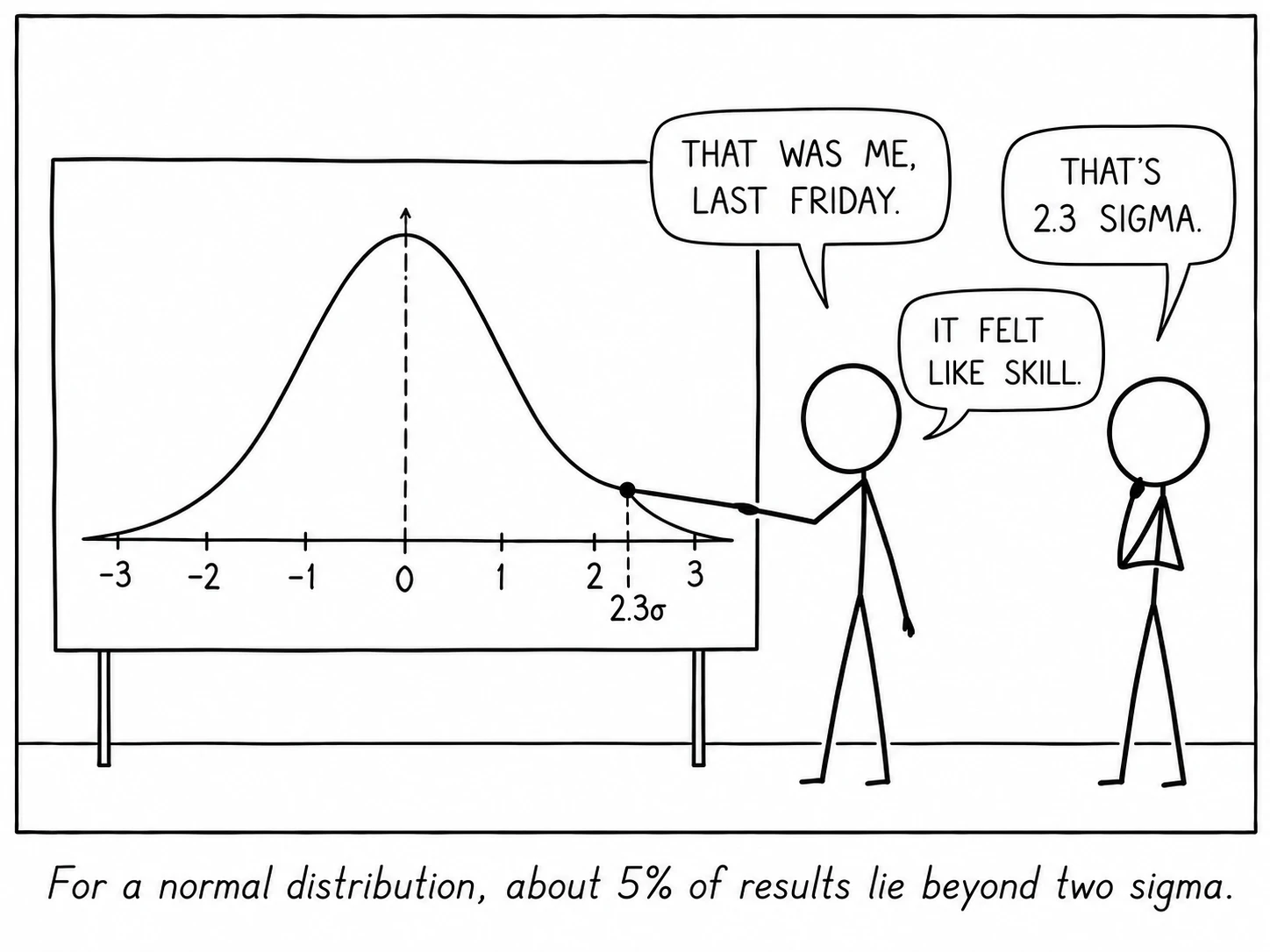
Under a normal approximation, about 5% of results lie more than two standard deviations from the mean.
Ol As bilong Save
- Feller, W. An Introduction to Probability Theory and Its Applications, Vol. 1.
- Ethier, S. N. The Doctrine of Chances: Probabilistic Aspects of Gambling.
- Taylor, D. G. Games, Gambling, and Probability: An Introduction to Mathematics, 2nd ed.