Hevi: Mak bilong Tebol
Martingale long $10 long tebol i gat mak $500. Hamas taim em i bruk, hamas mani em i lusim taim em i bruk, na sapos mak i go antap, em i helpim?
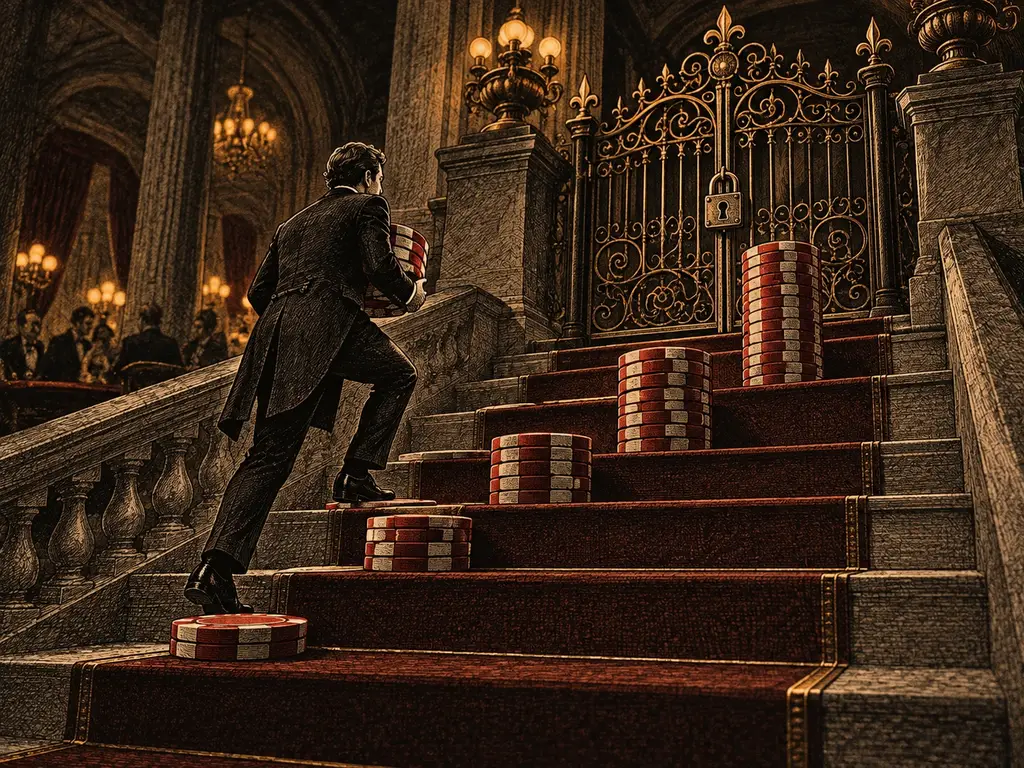
Sikispela lus wanpela bihain long narapela i brukim: 1.8% long wanpela saikel, klostu 60% bilong ol sesen bilong 100 tanim. Bruk i kostim $630. Sapos mak i go antap long $5,000, bruk i no save kamap planti (0.25% long wanpela saikel), tasol em i bikpela moa ($5,110). Avarej lus long wanwan dola yu betim em 2.70% long wanem mak.
Hevi
Assume independent spinsmatematikOl tanim i no hangamap long narapelaOlgeta tanim i gat wankain sans, maski wanem samting i kamap bipo. Olgeta kaunim long dispela sait i sanap long dispela.Ritim olgeta → and standard single-zerowilSiroWanpela grinpela hul we i no gat bet wan-long-wan, dosen o kolam i karamapim; em i as bilong edj bilong kasino. Narapela nem: wanpela siro, 0.Ritim olgeta → payoutsmaniPeMani bet i win i givim yu, ol i tok olsem “X long 1”, antap long mani bilong bet i kam bek.Ritim olgeta →, with enough bankrollmaniMani bilong pilaiOlgeta mani yu putim long sait bilong pilai. Lukautim mani bilong pilai em i makim hamas long en yu redi long lusim long wanpela bet na long wanpela sesen.Ritim olgeta → to fund each permitted stake. A player bets $10 on redbetRetBet wan-long-wan long 18 namba ret. Tok Frans: rouge.Ritim olgeta → and doubles after each loss, resetting after a win. The table maximum is $500. (a) How many consecutive losses break the progressionstratejiProgresenWanem lo i senisim mani bilong bet long ol resal i go pinis. Negative progresen i mekim bet i go antap bihain long lus, positive progresen bihain long win.Ritim olgeta →? (b) What is the probabilitymatematikSansSans bilong wanpela resal, long 0 i go 1 o 0% i go 100%. Wanpela namba: 1/37 = 2.70%.Ritim olgeta → per cycle? (c) What is lost at the break? (d) How does a $5,000 limit change the answers? (e) Does any limit make the system profitable?
Bekim (a)–(c)
Ol mani bilong bet: 10, 20, 40, 80, 160, 320. Namba seven bai 640 > 500, olsem na sikispela lus i brukim. (b) p(lus) = 19/37 long ret; (19/37)⁶ = 0.0183, klostu 1.8% long wanpela saikel. Wanpela saikel i stap klostu tupela tanim long avarej. Olsem na sesen bilong 100 tanim i gat klostu 50 saikel, na p(wanpela bruk o moa) ≈ 1 − 0.9817⁵⁰ ≈ 60%. (c) 10 + 20 + 40 + 80 + 160 + 320 = $630. Em 63 yunitmaniYunitMani bilong bet bilong stat we wanpela sistem o wanpela pleia i wok long en. Ol i stori long ol progresen long yunit, olsem na ol i ken wok long wanem tebol.Ritim olgeta → bilong stat bet, na saikel i bin traim long winim $10 tasol.
Bekim (d)
At $5,000: stakes to 2,560 are allowed; the tenth stake, 5,120, is refused. Nine losses break it: (19/37)⁹ ≈ 0.25% per cycle, about 11% of 100-spin sessions. Loss at the break: 10 + 20 + … + 2,560 = $5,110. The player has bought a rarer catastrophe at the price of a larger one. Over many sessions the expected cost of breaks is p × loss ≈ 0.0183 × 630 = $11.5 per cycle at the $500 limit and 0.0025 × 5,110 = $12.8 at $5,000; each is the expected contribution from failed cycles. Subtract the expected profit from successful cycles, $10 × (1 − p), to obtain total expected lossmatematikAvarej lusEkspektet velyu taims olgeta mani yu betim; avarej mani yu lusim long wanpela sesen o long wanpela taim.Ritim olgeta → per cycle: about $1.74 and $2.71 respectively.
Bekim (e)
With a finite limit and a well-defined stopping rule, expected loss equals expected turnovermaniOlgeta mani yu betimOlgeta mani yu betim long wanpela sesen o long wanpela taim, wantaim mani yu win na yu betim gen. Narapela nem: handle, action.Ritim olgeta → divided by 37. Changing the limit can change turnover substantially. For the 100-spin examples below, the player resets to $10 after either a win or a failed progression, and has enough money to place every bet. These are exact model expectations, not a simulation. The imaginary unlimited-bankroll, unlimited-stake MartingalestratejiMartingaleProgresen i mekim bet i dabel bihain long olgeta lus. Lukim hap Strateji long wanem samting em i mekim na i no mekim.Ritim olgeta → is different: a single cycle eventually wins $10 with probability 1, but its expected turnover is infinite. The finite-expectation identity cannot be applied to that unbounded stopping problem. Real bankrolls and tables cannot implement it.
Tupela tebol tru
Eksampel bilong Thorp em tebol bilong $1 wantaim mak antap $1,000. Wanpela pleia i laik winim $30 bilong kaikai long nait, wanpela dola long wanpela taim. Ol mani bilong bet 1, 2, 4 … 512 i givim ten bet, olsem na ten lus wanpela bihain long narapela i brukim progresen. Em i kamap wanpela taim long 785 saikel long wil bilong Yurop (wanpela taim long 613 long wil bilong Amerika), na i kostim $1,023. Tetipela saikel olgeta i win 96.2% bilong taim. Narapela 3.8% i lusim klostu $1,000, na avarej risalt bilong nait em −$9.17. Em stret 1/37 bilong $339 tetipela saikel i betim long avarej. Tebol bilong $5 wantaim mak antap $2,000 i no narakain: ol mani bilong bet i go inap $1,280 i givim nainpela bet. Bruk i kamap wanpela taim long 403 saikel long wil bilong Yurop (wanpela taim long 323 long wil bilong Amerika), na i kostim $2,555.
Wanpela pleia i gat planti mani
The table maximum is only one constraint. The player may run out of money before reaching it. A simulation must state whether it stops, resets to the base stake or bets the remaining balance when the next double is unaffordable. Those choices change session probabilities, so results from one rule cannot describe every Martingale strategy.
Skul bilong en
A higher limit permits rarer but larger failed progressions. It does not remove the negative expectation of each standard bet, and it may increase the amount wagered. Compare the total exposure and stopping rule as well as the chance of a short winning cycle.
Fomula
Ol askim
Em i helpim yu long stap inap long mak i antap moa, we bruk i no save kamap planti tasol em i bikpela moa. Avarej lus long wanwan dola i no senis.
Ol mani bilong bet 10, 30, 70, 150, 310: yu kisim mak $500 bihain long faivpela lus, na bruk i kostim $570. Wankain 2.70%.
A maximum limits the payout exposure accepted on a bet. The operator sets the actual limits; their existence does not create roulette’s house edgematematikEdj bilong kasinoHap bilong olgeta mani bilong bet kasino i holim long avarej: 2.70% long rulet bilong Yurop.Ritim olgeta →.
Amamas wantaim Matematik
Traim ol dispela yu yet pastaim. Bekim bilong wanwan i hait; opim taim yu redi.
A MartingalestratejiMartingaleProgresen i mekim bet i dabel bihain long olgeta lus. Lukim hap Strateji long wanem samting em i mekim na i no mekim.Ritim olgeta → starts at $100 on redbetRetBet wan-long-wan long 18 namba ret. Tok Frans: rouge.Ritim olgeta → and allows itself at most n bets a cycle: after n losses in a row it gives up and starts again. Write the average result of one cycle as a formula in n, and work it out for 5, 6 and 7 bets on a European wheel. Assume independent uniform single-zerowilSiroWanpela grinpela hul we i no gat bet wan-long-wan, dosen o kolam i karamapim; em i as bilong edj bilong kasino. Narapela nem: wanpela siro, 0.Ritim olgeta → results and sufficient funds for every permitted stake.
Soim bekim
Bekim Avarej em 100 × (1 − (38/37)ⁿ): −$14.26 long 5 bet, −$17.35 long 6 na −$20.52 long 7. Sapos yu larim moa bet, avarej saikel i kamap nogut moa, i no gutpela moa.
A cycle wins $100 unless all n bets lose, which happens with chance qⁿ, where q = 19/37. When they all lose, the stakes 100, 200 … 100 × 2ⁿ⁻¹ add up to 100 × (2ⁿ − 1). So the average is 100 × (1 − qⁿ) − 100 × (2ⁿ − 1) × qⁿ = 100 × (1 − (2q)ⁿ).
Here 2q = 38/37, a little more than 1, so (2q)ⁿ grows with n and the average falls: n = 5 gives 1.1426 and −$14.26; n = 6 gives 1.1735 and −$17.35; n = 7 gives 1.2052 and −$20.52. A longer ladder loses less often, in 3.6%, 1.8% and 0.9% of cycles, but each loss is twice as large, and more money crosses the table each cycle, at 2.70% of every bet.
On an American wheel 2q = 40/38 and the figures are −$29.24, −$36.04 and −$43.20. In a game with no zero 2q = 1, and every cycle averages exactly zero however long the ladder.
“Grand Martingale” i dabolim bet bihain long lus na i putim wanpela yunitmaniYunitMani bilong bet bilong stat we wanpela sistem o wanpela pleia i wok long en. Ol i stori long ol progresen long yunit, olsem na ol i ken wok long wanem tebol.Ritim olgeta → moa, olsem na ol bet i go 1, 3, 7, 15, 31 … Yu stap antap hamas taim win namba wan i kamap long bet namba 1, 2, 3 o k? Long yunit $10 na bikpela bet $500, hamas taim saikel i bruk, na wanpela saikel i kostim hamas long avarej?
Soim bekim
Bekim Win long bet namba k i lusim yu k yunit antap: +1, +2, +3 na i go olsem. Long $10 na $500 saikel i bruk bihain long faivpela lus, 3.57% bilong ol saikel, long −$570. Long avarej wanpela saikel i lusim $2.32 long $85.73 yu betim: 2.70%.
The kth stake is 2ᵏ − 1 units: 1, 3, 7, 15, 31. The first k − 1 stakes add up to 2ᵏ − 2 − (k − 1) = 2ᵏ − k − 1. A win on the kth bet pays 2ᵏ − 1, so the cycle ends (2ᵏ − 1) − (2ᵏ − k − 1) = k units up: one extra unit for every loss before the win.
At least $570 is needed to fund all five stakes in a fresh cycle. At $10 a unit the stakes are $10, $30, $70, $150 and $310; the next, $630, is over the $500 maximum. Five losses in a row, (19/37)⁵ = 3.57%, cost 10 + 30 + 70 + 150 + 310 = $570.
Average: the wins bring in $10 × k with chance (19/37)ᵏ⁻¹ × 18/37 for k = 1 to 5, and the break takes $570 with chance 3.57%; together −$2.32. The money staked averages $85.73 a cycle, and 2.32/85.73 = 2.70%. The ordinary Martingale at the same table breaks after six losses, 1.83% of cycles, for −$630, and loses $1.74 out of $64.20 staked: 2.70% again.
Wanpela pleia i plen long pilai Martingale long ret wantaim bet namba wan $1 long tebol i gat mak $1,000, olsem na ten bet inap: $1, $2, $4 na i go antap inap $512. Hamas taim wanpela saikel i lusim olgeta ten, hamas taim dispela i kisim long avarej, na hamas taim nait bilong 200 bet i pinis olsem?
Soim bekim
Bekim Wanpela saikel i lusim olgeta ten klostu wanpela taim long 784, na dispela i kostim $1,023. Em klostu 1,600 bet long avarej, na nait bilong 200 bet i paitim banis klostu 11% bilong taim. Wanpela saikel i lusim yet $0.31 long avarej long $11.31 yu betim: 2.70%.
Bet long ret i lus wantaim sans 19/37, wantaim siro. Ten i bihainim narapela: (19/37)¹⁰ ≈ 0.00128, klostu 1 long 784. Ol bet 1 + 2 + 4 + … + 512 i bung i kamap $1,023.
Wanpela saikel i kisim 2.05 bet long avarej, olsem na 784 saikel i kisim klostu 1,600 bet. Sapos yu kaunim tanim bihain long tanim, ran bilong ten lus i kamap long wanpela hap long 200 bet 11.3% bilong taim.
Namel long ol bikpela lus, pleia i winim $1 long wanwan saikel: klostu $783 pastaim long saikel nogut, na bihain −$1,023, klostu −$240 long olgeta taim. Long wanwan saikel: 1 × (1 − 0.00128) − 1,023 × 0.00128 ≈ −$0.31. Mani yu betim long wanwan saikel: 1 + 2 × (19/37) + 4 × (19/37)² + … + 512 × (19/37)⁹ ≈ $11.31. Na −0.31/11.31 = −2.70%.
Skelim wantaim bet namba wan $10 long mak $500, sikispela bet: banis i kamap wanpela taim long 55 saikel, na nait bilong 200 bet i paitim em 84% bilong taim. Mak i antap moa i mekim bikpela lus i no save kamap planti na i bikpela moa, i no kostim liklik moa.
Liklik lap
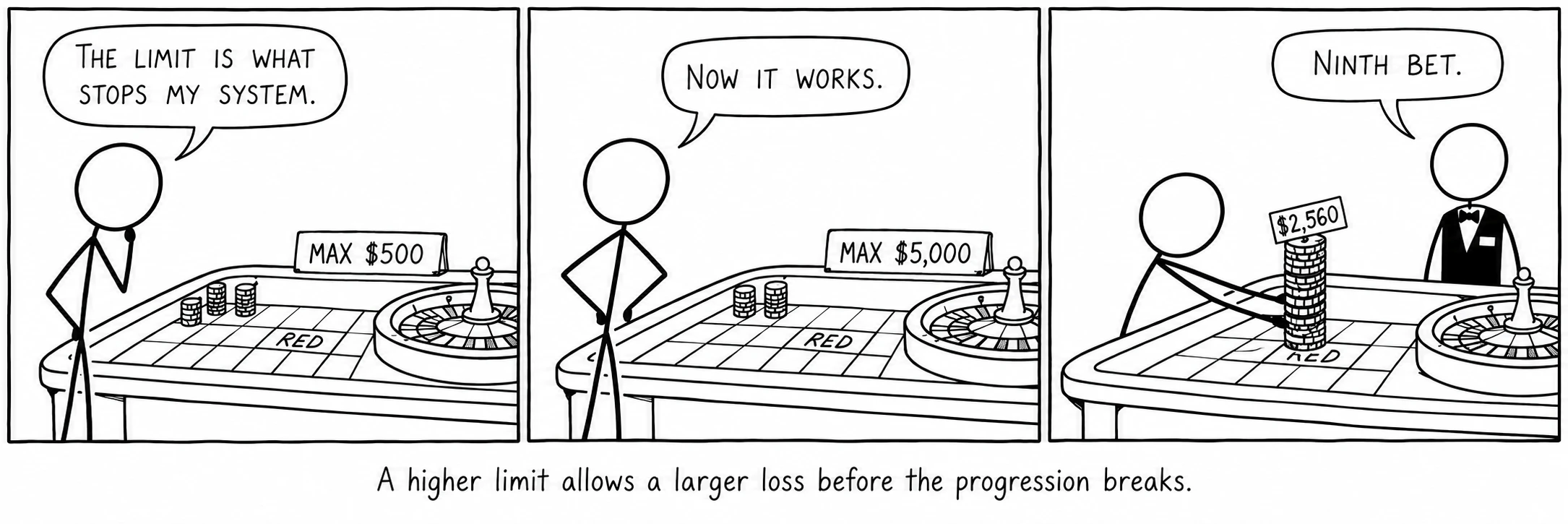
I no save kamap planti na i bikpela moa, long olgeta mak. Tupela i bung i no senis.
Ol As bilong Save
- Ethier, S. N. The Doctrine of Chances: Probabilistic Aspects of Gambling.
- Thorp, E. O. “Optimal gambling systems for favorable games.”
- Thorp, E. O. The Mathematics of Gambling.
- Epstein, R. A. The Theory of Gambling and Statistical Logic, 2nd ed.